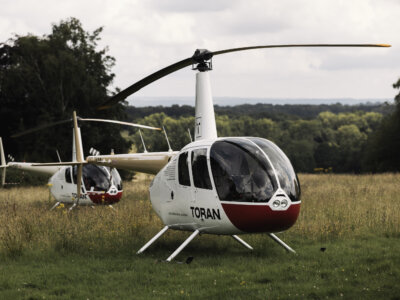
Lesson 2: Autorotation – how to land a helicopter without an engine
In our ‘second lesson’ I would like to talk about another concept that will sound familiar to every helicopter enthusiast, namely “autorotation”.
Autorotation is a manoeuvre in which a helicopter can be landed safely in the event of engine or transmission failure. The important thing here is that, as a pilot, you always remember that “Rotor RPM = LIFE”; as long as the rotor speed remains high enough, the energy in the rotor can be used to land the helicopter safely. A helicopter's drivetrain is designed in such a way that the rotor can keep turning in the event of engine failure. Compare it with the wheels of a bicycle that keep turning even if you keep the pedals still.
In our first lesson we saw that the pilot can increase lift by moving the collective up. This increases the angle of attack of the rotor blades. This also creates more drag. As long as the engine is running, this force is overcome by the engine power. Once the engine fails or can no longer deliver sufficient power, the drag will cause the rotor speed to decrease.

The pilot can therefore reduce the drag by lowering the collective. The rotor blade then encounters less resistance because it lies more parallel to the airflow. Think back to the previous lesson where I made the comparison with a hand someone sticks out of the window of a moving car. If that person holds their hand horizontally, they feel much less air resistance than if they hold their hand vertically in the wind.

In the event of sudden engine failure, the pilot must react quickly and lower the collective. This prevents the rotor speed from dropping so sharply that a safe autorotation is no longer possible. By lowering the collective, the helicopter begins to descend. The airflow will, as it were, flow from bottom to top through the rotor disc. The same effect occurs as with a windmill, where the wind makes the blades turn.
Despite the fact that the engine no longer delivers any power, the helicopter therefore “glides” down because the rotor blades are still turning and producing some lift. Because the main and tail rotors are mechanically connected to each other, the tail rotor is driven by the main rotor. The pilot can therefore still use the pedals.
The ideal forward speed for an autorotation is lower than the normal cruising speed. The rate of descent is of course higher than that of a normal descent, but don't expect any big butterflies in your stomach and certainly no objects flying around the cockpit. During a normal landing we need engine power to come to a “hover” and set the helicopter down on the ground. In the case of an autorotation we therefore need another way to get the helicopter safely to the ground.

This brings us to another important part of the autorotation, the flare. The flare is initiated by pulling the cyclic stick towards you. This tilts the rotor disc backwards. The flare has a dual effect. On the one hand, the rate of descent is reduced. On the other hand, the forward speed is taken out of the manoeuvre. After a short time the effect of our flare has worn off and we find ourselves in a helicopter with its nose pointing upwards, not an ideal way to reach the ground.
At low altitude we bring the helicopter into a horizontal position by pushing the cyclic stick forward. This is followed by a final action with the collective. Here we extract all the energy from the rotor to make the landing as soft as possible. The upward movement must be done in a measured way. We can therefore only carry out this manoeuvre once.

A successful autorotation depends on various factors: wind, weight, landing site, terrain, etc. Depending on the situation, the helicopter touches down with no or little forward speed.
We, as a helicopter school, place very strong emphasis at Toran Heli Academy on teaching this manoeuvre. Every future pilot must be able to give the helicopter and its occupants a safe landing, even in a situation of engine failure. To learn such a manoeuvre properly, a good ‘FI’ or flight instructor is of great importance.

Toran would like to introduce its new FI Jacob Dewagtere (see photo). Jacob successfully studied Aviation Technology at VIVES University College in Ostend and afterwards graduated Cum Laude from the VUB as an industrial engineer in aerospace engineering. At Heli-Austria in Austria he completed his CPL(H) training and then went to work as a helicopter technician at Air Technology Belgium. Today, Jacob is one of the flight instructors who can teach you autorotation perfectly!
Credits
- Photos, drawings and text © C. Comyn – Toran Helicopter Academy
Article source: https://www.helispot.be/hs/page/detail.asp?oid=b4D3G3D2
-
Blog
Lesson 3: Helicopter engines
In our lesson 2, we explained what autorotation is and how we perform it. One scenario in which we have to perform an autorotation is when, for example, the…
-
Blog
Lesson 4: No Ice Thanks, the dangers of the carburettor
In our previous lesson we saw that in a piston engine a mixture of fuel and air is brought to the cylinder, after which a “spark plug” ignites this mixture.…
-
Blog
Toran is flying along with De Warmste Week!
Let's build together towards a future in which every dream counts and every child gets the chance to shine.
